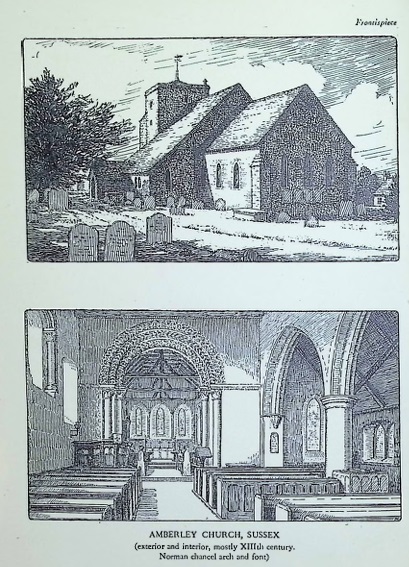
HOW TO STUDY AN
OLD CHURCH
By
A. NEEDHAM, F.R.S.A., A.M.C.
With an Introduction by
J. LITTLEJOHNS, R.L, R.B.A., R.C.A.
With 450 drawings by the Author
B. T. BATSFORD LTD.
15 NORTH AUDLEY STREET, LONDON, W.i
AND MALVERN WELLS, WORCESTERSHIRE
First published Summer 1944
You have wandered round this ancient church and have enjoyed
the peace and rest of its atmosphere.
Did you think, as you looked at the font, of the many thousand
children who have been admitted here into the membership of the
Church ?
As you stood before the Lord’s Table, were you one, in imagination, with those innumerable men and women who in every
generation have here received Christ’s special blessing?
Our forefathers first built this church and then maintained it
with care and devotion.
It is now our heritage and our responsibility. It demands our
unceasing service for its maintenance and repair.
Will you help us by playing your part?
Notice in Hawkhurst Church, Kent (slightly adapted).
MADE AND PRINTED IN GREAT BRITAIN
BY T. AND A. CONSTABLE LTD. AT THE UNIVERSITY PRESS, EDINBURGH,
FOR THE PUBUSHERS, B. T. BATSFORD LTD.,
LONDON, AND MALVERN WELLS, WORCESTERSHIRE
FOREWORD
The majority of small guide books to old churches previously
published describe them by means of much letterpress accompanied
by few illustrations. This book reverses that policy. It is arranged
to impart information at a glance, by means of a large number of
illustrations. Visitors to churches should be able, by reference to
these illustrations, to recognise all objects of interest. Attached to
each page of illustrations are brief notes, while the other pages
contain fuller details, under various headings for easy reference.
The information in this book is intended for those who like to
look at our old churches, but have not time to delve deeply into
church history and architecture. All interesting facts are presented
as briefly as possible.
With the exception of stained glass, which requires colour to
portray it, and church plate, which is not usually accessible to the
ordinary visitor, the illustrations, drawn from a large number of
churches visited, show virtually all the objects of interest. No
one church will contain them all, and some have only few, chiefly
owing to destruction by 16th century Reformers and 19th century
restorers, but visitors can, with the aid of this book and a little
imagination, picture the appearance of our churches in Medieval
Times, when they were filled with treasures of craftsmanship of
which only some remain.
The illustrations, with some exceptions referred to below, are
intended to convey a general impression of each object, as, owing
to the small size of many of them, due to the large number included
on each page, minor details had to be omitted. It has also been
impossible to avoid in the setting out of the illustrations, some
discrepancies of scale, in order that the smaller subjects can be
reproduced to an intelligible size. It must be understood that
the exigencies of space have necessarily caused the drawings to
be set close together, and I have not hesitated to sacrifice appearance to comprehensiveness, which I have felt was the most important factor, and I do not think that the inevitable crowding
of the subjects is an overwhelming disadvantage. To facilitate
their use as references, the head-coverings on Plate XVII and the
emblems, etc., on Plate XXVI are drawn in outline only, as small
perspective drawings in light and shade would hide some of the
necessary details. The plans, roof trusses, and arches, on Plates
IX, XXII, and XXIII, are diagrams to illustrate the gradual development of these forms.
The book is largely self-indexing according to the grouped
subjects shown in the Contents, and it is felt that in a concise
handbook there is no occasion for an extremely long Index. The
main subjects have, however, been included in the brief Index at
the end.
For those who wish to use the book as a guide to the original
objects from which the drawings were made, in order to study in
detail the beauty of the craftsmanship that the small size of the
illustrations makes it impossible to convey, the names of the
churches containing them are given as far as is possible. Unfortunately some of the sketches, which were made over a period
of many years, did not contain a note of the building, and memory
has failed to recall, in every such case, the name of the church,
but a number of these are typical examples to be found in many
churches.
The Introduction and Explanatory Remarks on pages 1 to 6
should be read before visiting the churches.
The author is deeply grateful to Dr. John F. Nichols, M.C.,
F.S.A., Hon. Director of the British Archaeological Association,
for his kindly interest and his invaluable advice.
A. N.
Haywards Heath,
Sussex.

INTRODUCTION
A few general remarks may be helpful to the reader before proceeding to the notes and illustrations.
To appreciate fully the beauties of our churches it is essential
to keep in mind the position they occupied, the purposes they
served, and the influence they wielded in Medieval Times.
They were not built only for worship at regular intervals, with
occasional services such as christenings, marriages and burials,
remaining empty more often than not; on the contrary, the parish
church was the centre of local communal life.
It was supported by all; it relieved the sick and needy; it was
used as a parish hall; the church house was the meeting-place of
the guilds; and even ale was brewed on the premises, sold for the
church funds, and drunk during dances and fairs in the churchyard.
The sexton, parish clerk and the churchwardens were far more
important persons in those days. The sexton acted as a kind of
town-crier proclaiming the obits and masses for the morrow. The
parish clerk assisted the parish priest, when Mass was said daily.
He rang the bell, prepared the altar, led the responses, and preceded the procession with holy water. When the priest visited
the sick the parish clerk led the way and carried the bell and candle.
On Sundays and great Feast Days he went round the parish, entered
the houses, and sprinkled the people with holy water.
The churchwardens were entrusted with more varied duties
than to-day. They had to keep accounts of everything connected
with church funds, collect rents of lands and houses left to the
church, farm the church stock of cattle, sell wool and cheese and
gifts in kind made to the church, organise ‘Church ales’ and ad
minister the funds for the relief of the needy, church repairs, etc.,
prosecute such offenders against the ecclesiastical law as adulterers
and Sabbath-breakers; they also acted as bankers and pawnbrokers,
the valuables entrusted to them being stored in the church; they
were responsible for the safe custody of the Maypole, and of bells
and coats used in the Morris dancing. After the Reformation they
had many civil duties to carry out, such as the provision of arms
for the Militia, relief of married soldiers, provision of pounds,
stocks and pillories, and the destruction of vermin.
It must be remembered, too, that the church was often a place
of refuge against marauders, which sometimes accounts for the
thickness of the walls and the smallness of the windows, and the
position of the church on the highest ground. Sometimes it served
as a shelter from the blasts of the storms.
Facts such as these, as will be seen later, reveal the significance
of many features of a church which would otherwise be of no
interest and might often be unnoticed. We cannot appreciate the
fragments that remain unless we can realise the full extent of their
ancient glories.
The Medieval Church was full of colour. The fragments help
us to imagine the effect of the mural paintings, sometimes of great
dramatic intensity, which covered the walls, the beautiful stained
glass windows, and the brilliance of the brightly coloured and
gilded carving. These formed the background to an elaborate
ritual with images, candles, banners, and priests with their splendid
vestments—experiences of moving beauty.
Compared with their original state, our churches appear cold
and bare after the ravages of time, and man. Stone has crumbled.
The living form of the creators has often been renovated tastelessly or replaced by incongruous substitutes. With the coming
of the Renaissance and its intellectual, religious and political upheavals the Church lost much of its ascendancy and the buildings
were denuded of much of their beauty. But in spite of all the
ravages there still remains a glorious heritage—evidence of
triumphant strivings to create things of beauty for a lofty purpose.
In attempting to appreciate these remains we need to remember
that many of the churches lack the symmetry and consistency of
their originals because each succeeding period of building, in re
pairing or extending the old, used its new architectural style.
The Black Death, that great plague of a.d. 1349-50, which
carried off about a third of the population, put an end to church
building for a time. Later, a great religious revival, and the doctrine
of Purgatory, formed important motives for building and rebuilding
of churches, and for nearly two hundred years few remained untouched, while over 1000 were rebuilt from the ground.
Thus a church originally Saxon may contain parts of every
later period—a Norman tower and font, a 13th century sedilia, a
14th century doorway, windows in every Gothic style, and a
Jacobean pulpit, with later tasteless accretions descending to the
most modern misfortunes. With a little knowledge of the evolution
of architectural styles, as given in this book, we can sometimes see,
in one building, birth, rise, fall and decay extending over more
than a thousand years.
One of the first questions the uninitiated visitor asks is ‘How
old is this church?’ It should be unnecessary to say that a state
of natural decay, especially of the exterior, is less often an evidence
of the age of the building than of the nature of the stone. Flint
and granite are almost changeless; sandstone may soon crumble.
The visitor to a church of comparatively recent date (say 15th
century) may be looking at an exterior which has been wholly
restored, some of it two or more times, and yet it is in an advanced
state of decay. Or he may find in parts of our most ancient churches
stones which are just as they were when the buildings were erected.
There is a good deal of false sentiment about the prevalent
delight in decay. Actually a well-restored exterior may give a far
better opportunity to realise how the building looked when in its
perfect state. This, however, seldom applies to the decorations.
The modern restoration may be more mechanically skilful, but
the copy lacks the personal expression of the original.
Usually we have to go inside the church to find original work
in much the same state as when it left the craftsmen’s hands. This
applies especially to wood carving, where the marks of the chisel
are sharp and clear after the passage of five or six hundred years.
Apart from the misleading evidences of decay, the age of a
building cannot always be determined by a knowledge of historic
styles, because there have been two periods of Gothic revival—
a small one in the 17th century and a much more considerable
one in the 19th century. But neither movement very greatly
affected the rural areas, because new churches were seldom called
for in the depopulating villages, though a number were erected.
Speaking generally, however, the style of architecture tells, within
about fifty years, when any part was built.
The whole evolution from Saxon to Perpendicular, i.e. from
the 7th to the 16th centuries, can be divided into fairly well-marked
periods, joined by transitions from one period to the next. The
dates of each period cannot be stated precisely because the changes
did not take place at exactly the same time in every part of the
country. But in round figures it is a sufficient indication to divide
the periods thus:
INTRODUCTION
Saxon 7th century to 1060
Norman and Transition 1060-1190
Early English and Transition 1190-1300
Decorated and Transition 1300-1375
Perpendicular and Transition 1375-1550
The changes of style are to be seen to some extent in every aspect
of construction and decoration—plan, roof, tower, arches, windows,
mouldings and decorations. But the only safe guides are the
details and decorations. Square-headed windows are characteristic
of the latest period but sometimes occur in earlier ones. There
are many exceptions to the plans associated with each period. The
shapes of arches are not a safe guide, because they sometimes vary
in most periods in accordance with constructional needs. But the
changes in the shapes of mouldings, arrangement of tracery, carved
patterns and foliage have evolved consistently.
Those of us who visit many churches come across curious and
exceptional features for which general information provides no
explanation. These are more likely to occur in out-of-the-way
places where the craftsmen may have been less acquainted with
prevailing ideas. In many churches booklets are obtainable for a
few pence, and the county archaeological society can supply
information. The writers hope that the necessarily abbreviated
notes accompanying the following illustrations will stimulate many
readers to pursue their enquiries among the more extensive works
on every branch of the subject. They can be assured that they
will be well repaid by the increased delight they derive from our
fascinating old churches.
J. LITTLEJOHNS
EXPLANATORY REMARKS
Explanatory remarks of the meanings of several items mentioned
in the text are given below:
Medieval Times or Middle Ages. Generally descriptive of
the period from the fall of Rome to the discovery of America,
but, for the purposes of this book, regarded as covering the 10th
to the 16th centuries inclusive.
Mass. The central act of worship of the Roman Catholic
Church performed daily; the climax of the ritual is the offering by
the priest at the altar of Christ’s Body and Blood as intercession for
the souls of the faithful, living and departed.
Host. The elements, bread and wine, consecrated at the altar,
and believed to have been changed thereby into the veritable
Body of Christ.
PYX. The receptacle, suspended over the altar or kept in a
locked aumbry, in which the Host (usually in the form of a consecrated wafer) is reserved for administration to the sick and dying, and for adoration by the congregation.
The Reformation. The great religious revolution of the 16th
century. The Church, more particularly the greater monasteries,
had accumulated much wealth, chiefly in the form of landed estates;
the upper clergy, often appointed by the Secular Authority on
political grounds, were frequently pluralists and absentees; there was
some slackness and self-indulgence, and many superstitious usages
had grown up; payments to the Papacy became burdensome and
the interference of the clerical courts in the lives of the people was
resented; the Reformers objected to the doctrine of transubstantiation (the belief that the bread and wine, when offered at the altar by the priest, were converted into the actual Body and Blood of Christ). Henry VIII, while claiming to be a Roman Catholic in
matters of doctrine, repudiated the authority of the Pope over the
Church in this country and assumed the position of Supreme Head
on earth of the Church of England; he also suppressed the
monasteries and confiscated their wealth. During the reign of his
successor, Edward VI, the Reformers grew in power; they
abolished the Latin Mass and introduced an English Prayer Book;
chantries were dissolved and the churches plundered of much of
the wealth in ornaments, vestments and sacred vessels. Next came
Queen Mary, who restored the Papal authority and the Mass and
ordered the burning of Protestant ‘heretics.’ Queen Elizabeth
reversed Mary’s policy and established the Church of England
substantially as it exists to-day: the final severance from Rome
came in 1570, when she was excommunicated by Pope Pius V.
Towards the end of her reign the Puritan movement, largely inspired by Calvinist teachings, gained ground and was the main
cause of the civil war in the reign of Charles I; it triumphed for
a short time during the Commonwealth, but the people as a whole
soon tired of the rigid Puritanical regime imposed by the Cromwellian soldiery; the Stuarts were restored in 1660, and the Settlement of 1662 removed the Puritan ministers and re-established
the Prayer Book of Elizabeth with certain minor modifications of
a ‘High Church’ character.
Puritans. A body of earnest religious reformers who aimed at
combining a stricter morality with a simpler form of worship;
they objected to the rule of bishops and to the term ‘priest’; and
to the use of set prayers and the wearing of vestments, were
anxious that the ‘Communion table’ should not be regarded as an
altar, and disapproved of church paintings and ornaments as
tending to superstition and idolatry in our churches. They were
responsible for the destruction of many of the artistic treasures that
had survived from the Middle Ages.
Visitors to our churches will find that the order in which the
pages of illustrations in this book are arranged forms the most
convenient way of going round, except that gravestones in the
churchyard could be left until the end of the visit if desired.
In the brief notes attached to each page of illustrations, objects
which are not very common are marked with an asterisk *, while
the words in brackets thus, (S. wall of the chancel), indicate the
part of the church where the object can usually be seen.
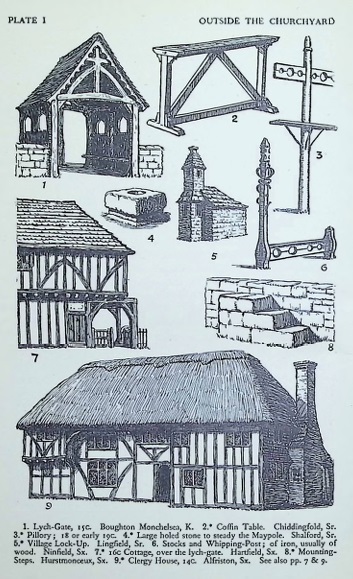
OUTSIDE THE CHURCHYARD
It is often worth while looking around a village for interesting
remains of ancient customs, a few of which are mentioned
below.
Pillory, No. 3. Evildoers were made to stand on the raised
platform with their head and arms through the holes in the
cross-piece while they were exposed to indignities from the
villagers.
Stocks and Whipping-Post, No. 6. The victims sat with
their legs locked in the stocks and received similar treatment to
those on the pillory. Those sentenced to receive lashes with a
whip stood with their hands fastened to the whipping-post and
their clothes stripped from their backs.
Ducking-Stool. A form of chair on wheels attached to a long
pole. Scolds and disorderly women were strapped in the chair
and ducked several times in the village pond. Only a very few of
these stools remain.
Lock-Up, No. 5. Used for confining law-breakers until they
could be brought before the proper authorities.
Maypole, No. 4. The first of May was kept as a festival to
celebrate the return of Spring. The Queen of May was chosen
and crowned with a garland of flowers. There was a procession
to the village green, dancing round the Maypole, and sports.
These celebrations were suppressed by the Puritans, revived after
the Restoration in 1660, and then gradually declined in importance.
Mounting-Steps, No. 8. For those who rode their horses to
church and were not very agile, these steps were helpful on re
mounting.
Clergy House, No. 9. Some of these 14th to 16th century
buildings are fine specimens of the old craftsmen’s skill and artistic
taste. Being near the church, they were convenient for the priest
to get to the many services he had to conduct each day. Only
a few of these are left. There are quite a number of beautiful
successors to these medieval clergy houses in the form of residences
for rectors and vicars.
IN THE CHURCHYARD (CROSSES, ETC.)
Tithe Barn. Payments ‘in kind’ to the clergy of corn, fodder,
etc., were stored in these Medieval barns, some of which were
of a great size.
Inn. In the days when pilgrims travelled long distances to do
homage at the shrine of some saint, guest houses or inns were
provided to accommodate them. Many of these inns remain,
bearing religious names, such as ‘The Cross,’ ‘Angel,’ ‘Mitre,’
‘Lamb,’ ‘Bell,’ ‘Star,’ ‘Cross Keys,’ etc. Although they have
been restored and partly rebuilt, many retain their old-world
atmosphere, and with oak beams and doors, quaint staircases,
large open fireplaces, odd nooks and corners, present a picturesque
appearance.
Lych-Gate, or ‘Corpse-Gate,’ Nos. i and 7. Lych was the
old English word for a dead body. At the lych-gate the coffin
was rested on a wooden or stone table, No. 2, while the priest
said part of the burial service. Only rich people were buried in
coffins in Medieval Days; the poor were brought in a parish one,
usually carried on the parish bier (a few of which still remain),
then taken out and wrapped in a sheet for burial direct in the
ground. To give impetus to the wool trade of the country, an
Act was passed in 1678 forbidding anyone, under a penalty of
to be buried unless they were wrapped in a woollen material.
The Act was repealed in 1814. Few lych-gates of a date earlier
than the 17th century remain. Many have been restored or rebuilt.
IN THE CHURCHYARD (CROSSES, ETC.)
In Medieval Times churchyards were busy places. On Feast
Days there were dancing and games, including ‘fives,’ which was
played amongst the buttresses of the church. Fairs were held at
definite times. Travelling merchants set up their stalls and booths
and plied a busy trade. Churchyards were not so full of graves
and gravestones in those days. In some cases the church was
built on the old heathen burial-ground; thus the churchyard
would be older than the church, or even the cross, which may
have been set up before the church was built.
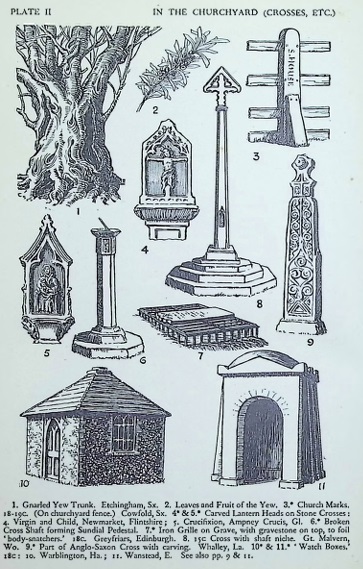
Yew Tree, No. 1. Old yew trees exist in many churchyards.
IN THE CHURCHYARD (CROSSES, ETC.)
They are, in some cases, older than the church. Ancient Britons
were pagans, and it is quite possible that the yew trees are vestiges
of the ‘groves’ in which the pagans worshipped. The trunks
and branches of very old yew trees are twisted and gnarled, but
still stand against the storms that beat upon them. They were
looked upon as the emblem of immortality. Edward I ordered
the planting of yew trees, as, by reason of their close growth,
they formed a protection for the church against high winds and
storms. Twigs and boughs of the tree were used to decorate the
churches at Easter, and were also used as a substitute for the palm
on Palm Sunday.
Crosses, Nos. 4, 5, 6, 8 and 9. A number of crosses were set up
by the missionaries from Rome to remind the people of Christ’s
sacrifice made for them, and used as positions to preach from
before the churches were built. The cross was an important
‘station’ in the Palm Sunday processions and was sometimes used
for public proclamations. Some had a niche in the shaft, No. 8,
for the pyx (a receptacle containing the Host). Anglo-Saxon
crosses were usually enriched with elaborate carving, No. 9, but
few of these remain. Later Medieval crosses were of two types:
lantern, Nos. 4 and 5, and those with arms, No. 8. Both types at
times were enriched with sculptured figures, Nos. 4 and 5.
Church Marks, No. 3. The names of near-by mansions or
farms carved on old churchyard fences indicated that the tenants
were responsible for keeping that part of the fence in a proper
state of repair, and are interesting reminders of the times when
the responsibility for the fabric, etc., of the church devolved on
all parishioners.
Watch Boxes, Nos. 10 and 11. In the 18th and early 19th
centuries, when surgical science was beginning to develop, die
prejudice against the dissection of bodies was so great that medical
students were driven to what was called ‘body-snatching,’ i.e.
removing the bodies of newly buried persons at night. To prevent
this, a small building, called a watch box, was erected in the church
yard, and in this, armed men were on guard at night to foil the
activities of ‘body-snatchers,’ or ‘resurrection men’ as they were
sometimes called. Another form of protection was a heavy iron
grille, No. 7, covering the grave, with the headstone placed on top
of the grille.
IN THE CHURCHYARD (HEADSTONES, ETC.)
The oldest graves are South of the church. People wished to
avoid the shadow of the church falling on their graves, and the
North side was often associated with the Devil. The churchyard
on the South side is often higher than the road outside and the
church door-sill. This is due to the Medieval custom of burying
people on top of others, and so gradually raising the level of the
ground. Few gravestones earlier than the 17th century remain.
Table Tombs, Nos. 1 and 13, followed the form of altar tombs
inside the church, and the tops, raised above the ground, did not
get overgrown with weeds. Provision was made by the wills of
some charitable persons for the distribution of bread and beer to
the poor. The tops of table tombs near the porch were some
times used for this purpose. The 18th and 19th century copies
of these old table tombs, No. 13, were often heavy and clumsy in
appearance.
Headstones, Nos. 2 to 6, 9 and 10, were counterparts in the
churchyard of the wall tablets within the church. Their purpose
was to display inscriptions giving details of the deceased persons.
Numerous examples, dating from the 17th century onwards, are
to be found in old churchyards, the earliest ones being low and
very thick. Small footstones preceded the use of headstones.
Some graves possess a ‘body,’ a long flat or rounded stone placed
horizontally between the vertical stones at the head and foot.
Many headstones were carved with classical emblems of mortality:
skull, crossbones, hour-glass (‘sands of time run out fast’), scythe
(‘death the reaper’), etc. Inverted torches, No. 3, are symbolical
of death, darkness and night, while uplifted torches signify life,
light and day. A serpent biting its tail and forming a circle, No. 4,
signifies Eternity. This example encloses the ‘All-seeing Eye’ of
God. The book and pen of the ‘Recording Angel’ are shown
by No. 6.
Bed-Head, No. 11. These are cheap wooden substitutes for
stone and are common in some counties. Being constructed of
wood, many have become dilapidated, but quite a considerable
number remain.
Iron, No. 12. In bygone days the smelting of iron was carried
on in Kent, Surrey and Sussex. In these counties iron was used

TOWERS AND SPIRES
for some gravestones in the church and churchyard, while in some
districts slate, No. 2, was utilised for the purpose.
Recessed Grave, No. 7. In very thick walls a recess was
constructed and formed a covering for the effigy which sometimes
rested in it.
Many modern headstones are made from white marble, a foreign
material which does not harmonise at all with the mellowed stone
of the old church.
Some epitaphs on headstones are quite amusing, while others
record tragedies. Three examples are given below.
To a pirate:
Pray then ye learned Clergy, show
Where can this brute Tom Goldsmith go?
Whose life was one continued evil,
Striving to cheat God, man and Devil.
To a soldier:
Here sleeps in peace a Hampshire Grenadier,
Who caught his death by drinking cold small beer,
Soldiers, be wise from his untimely fall,
And when you’re hot, drink Strong or none at all.
To a murdered sailor:
When pitying eyes to see my Grave shall come,
And with a generous Tear bedew my Tomb,
Here shall they read my melancholy Fate,
With Murder and Barbarity complete,
In perfect Health and in Flower of Age,
I fell a victim to three Ruffians’ Rage.
On bended Knees, I mercy strove to obtain,
Their thirst of Blood made all entreaties vain,
No dear Relation or still dearer Friend,
Weeps my hard lot or miserable end,
Yet o’er my Sad Remains (my name unknown),
A generous Public have inscribed this Stone.
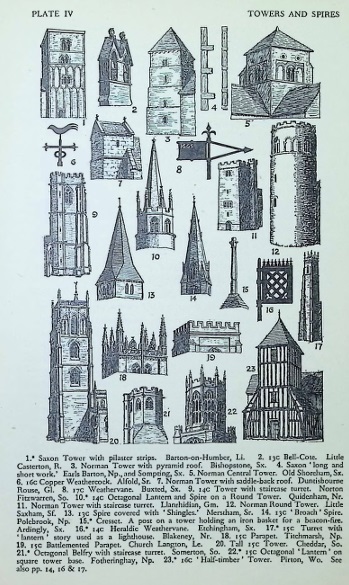
TOWERS AND SPIRES
Towers appear like giant sentinels watching over the people.
Their primary use is to house bells, to call people to worship,
and spread tidings, joyful and sad. Bells are heavy, and so towers
are strongly built. In Medieval Times towers were useful as a
defence against marauding bands, and were guides for travellers
by land and sea. At night a beacon-fire, No. 15, or lamps in the
TOWERS AND SPIRES
windows of a ‘lantern’ upper story, Nos. 17 and 22, were used.
Some small churches have no tower, bells being housed in an
opening at the apex of the Western gable or a bell-cote, No. 2,
above it.
Position. This varies according to convenience. The majority
being at the West end, some are central, Nos. 5 and 7, others are
attached to a transept or the nave, sometimes with their lower
story as a porch. A few are detached.
Shape. The majority are square, Nos. 1, 3, 5, 9, 11, 17 and 20,
a small number rectangular, some, in districts devoid of large
stones necessary for the angles of square towers, are round, No. 12,
and a few with the upper story octagonal on a square or round
base, Nos. 10 and 21. Belfry windows are really ‘sound-holes,’
filled with louvres allowing the notes of the bells to radiate. Access
to the upper,stories is by an interior ladder (see Plate XXIV), or
a staircase turret, Nos. 9, 11 and 21. An effect of stability was
obtained by the width of the tower receding to the top, either by
‘battering,’ No. 11, stepped upper stories, No. 3, or buttresses
projecting less stage by stage, Nos. 9, 17 and 20.
Roof. Many early towers lack their original roof. Saxon roofs
were probably similar to Norman, a form of low pyramid, Nos. 3
and 5. A few 12th and 13th century ones had a ‘saddle-back’
roof, No. 7. In the 13th century the pyramid form became taller,
developing into the spire, No. 13, covered with oak ‘shingles,’ lead
or copper. ‘Broach’ spires, No. 14, were common in the 13th
century; later, in the 14th century, spires rose behind parapets,
No. 10. Not many spires were built in the 15th century, most
roofs being flat, behind parapets, Nos. 18, 19 and 20. Copper
weathercocks, No. 6, symbolic of vigilance, and weathervanes,
Nos. 8 and 16, decorated with coat-of-arms, emblems of saints,
etc., are interesting remains of old craftsmen’s work.
There is space only for a few brief indications of styles. Windows,
doors, buttresses and decorative details are characteristic of their
periods (see Plates V, VI and VII), but some early towers have
been altered and added to in later times.
Saxon towers, No. 1, with double belfry windows, ‘long and
short work,’ No. 4, and pilaster strips as decoration, No. 1, are
taller than the low massive Norman* ones, which seldom rise much
above the church roof. Corbel tables (see Plate V) and staircase
EXTERIOR WALLS OF CHURCH (BUTTRESSES, ETC.)
turrets, No. 11, are found on Norman towers. Some 13th century
towers are low, others more lofty; belfry windows are larger and
recessed. In the 14th century belfry windows are the central
feature and richer decorative details were used. The 15th century
was a period of magnificence in tower building, Nos. 18 and 20;
some are very tall, often, if added to an earlier church, dwarfing
the building; windows are large and some parapets richly decorated,
Nos. 18 and 20. In forest districts in the 16th century a few towers
were built in the ‘half-timber’ style, No. 23, with oak framework
filled in with a form of cement.
EXTERIOR WALLS OF CHURCH (BUTTRESSES, ETC.)
Buttress, Nos. 16 to 21. The weight of a roof tends to thrust
the walls outwards, therefore it is necessary to construct walls
that are very thick, or strengthen them with built-on projections,
called buttresses. These are usually placed at points where the
roof trusses (see Plate XXII) are fixed. Buttresses give support
in proportion to their weight, so the thinner the wall, the heavier
the buttresses should be.
Many Norman walls are at least three feet in thickness, and
their buttresses, No. 16, which are really pilasters with little projection, just tend to stiffen the walls and serve a decorative purpose
in breaking the monotony of a large plain wall surface. In the
13th to 15th centuries walls became thinner, and being weakened
by larger window openings, the projection of the buttresses was
gradually increased, Nos. 17 to 20. Some have pinnacles at the
top, No. 18, which add to the weight, tend to throw off the
rain, and serve to beautify the skyline of the building. Some
buttresses have a niche, No. 19, to house the statue of a saint, and
in the later part of the 15th century carved panelling was used
as decoration, No. 21. When the nave walls were raised to take
the clerestory windows (see page 21), they were occasionally
strengthened by an arched-shape stone construction between this
wall and the buttress of the aisle wall, known as a flying buttress,
No. 13.
Corbel Table, Gargoyles, and Parapets, Nos. 1 to 4, 7 to
12 and 15. To throw the rain from the roofs clear of the walls,

EXTERIOR WALLS OF CHURCH (WINDOWS, ETC.)
in early times projecting roofs were used, these being carried on
corbel tables, No. i, a form of cornice supported by corbels,
Nos. 2, 3 and 4. Many of these corbels were carved with quaint
heads and figures. Later, gutters, with gargoyles, a kind of stone
water-spout, Nos. 10 to 12 and 15, were used. The common
belief was that dragons and demons infested the church. Carved
forms of these were used for gargoyles, so that they were thus
made to protect the church they wished to destroy. Others
represented human vices as a warning to all who entered the
church to leave their evil passions outside. In the 14th and 15th
centuries some walls were elevated above the gutters in the form
of parapets, often like a battlement with carved details, Nos. 7 to 9.
‘Mass’ or ‘Scratch’ Dials, Nos. 5 and 6. A form of sundial used
to mark the times of the church services before mechanical clocks
began to be more commonly used in the 15th century. In Medieval
Times the walls of churches were coated with a form of cement
and limewashed both inside and outside, and mass dials were
usually painted in the scratched lines. A metal rod, called a gnomon,
projected from the central hole to cast the shadow.
In the 18th century, sundials, No. 14, were used to mark the
hours of the day.
Consecration Crosses, Nos. 22 and 23. For the dedication
of the church twelve crosses were carved or painted, or metal ones
fixed, outside and inside the walls of the church. These were
anointed with holy oil by the bishop. There may be, above or
below the crosses, a hole for the bracket for the candle used at the
ceremony. Candles were also lighted on the anniversary of
consecration day. These crosses were about seven to eight feet
above-ground to prevent passers-by brushing against them. The
bishop used a short ladder to reach them.
EXTERIOR WALLS OF CHURCH (WINDOWS, ETC.)
Windows. Saxon, Norman and early 13th century windows,
Nos. 1 to 6, were small. Glass being expensive, they were unglazed or filled with horn, parchment or oiled silk to exclude the
wind and rain. Windows placed high up in the wall tended to
reduce discomfort from draughts. These 12th and 13th century

EXTERIOR WALLS OF CHURCH (WINDOWS, ETC.)
windows were splayed inside, Nos. 4 and 6, to admit more light,
but, as they were small and few in number, churches were gloomy.
In the 13th century, to secure more light, two or more ‘Lancet’
windows, with circular openings over them, No. 9, were placed
close together under a dripstone (an arched moulding which prevented rain running down the wall into the window); this arrangement was known as Plate Tracery and was the origin of—
Bar Tracery, Nos. 7, 8, 10, 11, 13 to 15. From the 13th to
the 16th centuries, as builders gained experience and glass became
cheaper, windows gradually increased in size, until some 15th
and 16th century churches had the appearance of a huge expanse
of glass held together by narrow strips of stone. Windows were
divided into divisions, called ‘lights,’ by ‘mullions’ (vertical bars
of stone), which developed at the top into curved bars forming
various shapes known as tracery. In the 15th and 16th centuries
large windows had ‘ transoms ’ (horizontal bars), No. 13, for additional strength. Besides being decorative, tracery acts as a
support to the window arch, and enables the glass to withstand
wind pressure. It gave Medieval craftsmen opportunities of filling
windows with beautiful stained-glass pictures (see page 70).
Tracery first consisted of geometrical shapes, No. 7; then, later
in the 14th century, flowing lines known as curvilinear tracery,
No. 8, were used.
Window Arches. Saxon and Norman were semi-circular and
13th century ones very pointed. As windows were built wider,
arches became less acute, until, in the 15th century, four-centred
ones, No. 14, were used. Some 14th century arches were ogee
shape, No. 15, while segmental arches, No. 10, and square heads,
No. 11, were used in the 14th to 16th centuries. Occasionally,
circular windows, No. 12, dating from Norman times onward can
be found.
Clerestory Windows. When a church was constructed with
aisles, or had them built on later, nave walls were raised above
the aisle roofs and windows inserted to add more light to the nave,
though some appear rather small for this purpose.
‘Low-Side’ Window, No. 16, was lower than the others, placed
at the West end of the chancel and usually on the South side, and,
in Medieval Times, had shutters to open and close. The purpose
of this window has aroused much controversy, but most authorities
PORCHES, ETC.
agree that the ‘Sanctus bell’ was rung there to remind those in
and outside the church of the solemn moment of the Mass when
the ‘Host’ was elevated at the altar.
Sanctus Bell-Cote, No. 17. Built over the West end of the
chancel on some churches to house the ‘Sanctus bell.’
Priests’ Door, No. 16. The chancel was the peculiar responsibility of the rector, and he had his own entrance. This was useful
at nights when he had to obtain the necessary articles if called to
visit die sick and dying.
Anchorite’s Cell, No. 18. Anchorites and anchoresses were
persons desirous of living pious lives. Each was conducted in a
procession to the cell, the door of which was blocked up and
sealed, die occupant spending the rest of his or her life in it. A
small window admitted light, and through this food was passed;
another window gave a view of the altar. Some cells had a fire
place. Few remain to-day.
PORCHES, ETC.
Porches, Nos. 5 and 7. Most churches have one on the South
side, some on the North if the old Manor House lay on that side.
There were few porches in die 12th and 13th centuries, but in the
14th century they began to be regarded as a necessity. Many old
ones were allowed to deteriorate and were replaced by new ones.
The porch was most important in Medieval Times. There penitents received absolution before entering the church; those
breaking vows did penance, and those breaking the marriage vows
stood, wrapped in a white sheet; women knelt to be ‘churched’
after the birth of their child, and baptismal services commenced;
marriage banns were called, part of the marriage service was held,
and the ring placed on the finger; civil business was carried out,
executors of wills made payment of legacies, coroners sometimes
held their courts, and public notices were exhibited. The porch
was one of the ‘stations’ during church processions. It protected
the church door against inclement weather. Stone porches were
built in all periods, while oak-framed ones on a stone base, No. 7,
were used in the 14th and 15th centuries. Most porches had a

PORCHES, ETC. “
niche, No. i, for a figure of the patron saint, while many seats
were of stone, No. 8, high and low, for adults and children. Some
porches have a room over them, No. 5, used for various purposes.
It provided a safe place for books and documents of the church
and parish, for the library that some churches possessed, and a
depository for wills. Some of these rooms were used by Chantry
Priests to sleep in to be ready to celebrate early Mass for travellers.
Frequently one of the conditions of a Chantry bequest was that
the priest should teach boys Latin, the language used for
church services; the room being used for this earliest form of
school. The responsibility for raising the local quota for Militia
service rested on the parish authorities, and armour was stored in
the room.
Stoups, Nos. 2 and 3. Recessed basins, outside or sometimes
just inside the church door, containing ‘holy water,’ consecrated
every Sunday. All entering the church dipped their finger in and
made the sign of the cross on their forehead and breast to remind
them of their baptismal vows, and the need of cleansing from sin,
and the frailty of human life, ‘unstable as water.’
Graffiti, Nos. 6 and 10. Interesting ancient markings of
various shapes cut in parts of the stonework of many churches,
the purpose of which cannot be definitely stated. It is thought
that some denote the registering of a vow, or were signs cut on
the eve of a venture, or, the crosses particularly, cut by pilgrims
pausing at the church on their journey to some shrine. These
crosses are known as ‘votive crosses’ or ‘pilgrim marks.’ Some
may have been cut to scare evil spirits away. The marks, No. 10,
may have been cut by stone-masons, proud of their work, much
as an artist puts his signature on his picture, or merely cut for the
convenience of reckoning piecework, etc.
Cresset Stone, No. 9. A stone with cup-like hollows filled
with oil and floating wicks to give light for those performing the
night duties in the church. Few of these remain.
Chain, No. 4. For drovers to tie up their cattle to prevent them
straying while they themselves attended Mass.
DOORS
There is the actual wooden door, also the opening and surrounding stone mouldings, etc., generally referred to as the door
way. Most early churches had South and North doors, some a
West one as well. The North door was known as the ‘Devil’s
Door,’ and was left open at baptismal services so that the evil
spirits supposed to be in the child could, when it was christened,
pass from the child through the doorway. This door was also
used for the procession, an important ceremony in Medieval
services. Those taking part passed through it down the centre
of the churchyard, round the East end of the church, and in again
by the South door. In some churchyards can still be seen the
path used for processions. The North door is often blocked up
now, due probably to the dislike of draughts.
Saxon doors were plain, but from Norman times onwards
doors were decorated to add beauty to them, probably with this
saying of Christ’s in mind, ‘I am the door: by me if any man
enter in, he shall be saved.’ Norman doors and doorways, Nos. 8,
10 and 16, were often the most elaborate feature of small churches;
some had a carved panel under the arch, No. 16, known as a
tympanum. In Saxon times, and 12th and early 13th centuries,
doors were strongly built. These proved useful if the church
had to resist attacks by robbers or invaders. They were constructed of thick oak boards, showing tool marks, placed vertically
outside and horizontally inside, Nos. 1 and 2, and fastened together
by long wrought-iron nails with ornamental heads, No. 3, that
were driven right through and clenched over on the inside.
Early doors often provided the sole surviving examples of the
work of the smith, that most important of Medieval craftsmen.
His work, consisting of wrought-iron hinges, locks, handles and
knockers, Nos. 5, 7 to 10 and 15, not only added beauty to the
door but greatly increased its strength. A part of Norman hinges,
Nos. 8 and 10, in the form of the letter C, was supposed to refer
to St. Clement, the patron saint of smiths. The churches afforded
temporary sanctuary for persons fleeing from processes of the law,
who no doubt used the knockers on the doors to gain entrance.
This privilege was abolished in the 17th century. In the 13th
century the ironwork was very elaborate, the outside face of the
doors being covered with scroll-work, No. 7.

PLANS
Later, in the 14th and 15th centuries, the craft of the carpenter
replaced that of the smith in door decoration. At first simple
mouldings were used to cover the joints, No. 6, then decorative
forms were copied from the tracery of the windows. These tracery
forms were first carved in the solid woodwork of the door, but
later were cut out of wooden boards and fixed to the door with
glue and nails, No. 14. Hinges and locks were smaller and plainer.
Most 13th and 14th century doorways were plain, but some 14th
century ones had an ogee-shaped ‘dripstone’ or ‘hood moulding’
as it is sometimes called, with crockets and finial carved for decoration, No. 13. 14th century dripstones were often finished with
carved heads of kings and queens, or knights and ladies. Many
15th century dripstones were square, having a four-centred arch
under, with the spandrils filled with shields, heraldry, tracery or
foliage, No. 4. Some churches had double doors, suggesting the
two natures of Christ, human and Divine. Large churches some
times had three doors, signifying the Holy Trinity.
PLANS
Church plans vary, but all can be traced back to one of three
types: (A) Nave and sanctuary, No. 1; (B) Nave, chancel and
sanctuary, No. 3, and No. 4 (chancel under the tower); (C) Cruciform with nave, chancel, transepts and central tower. Type (B)
did not continue as a permanent form.
From the 7th to the 16th centuries, churches were primarily
shelters for altars. People attended church to see and hear priests
celebrate Mass. Aisles were added to accommodate more altars,
larger congregations, and provide paths for processions; chancels
lengthened for increased ritual; porches, sacristies, towers and
chantry chapels built on, until often little remained of the original
church. Nos. 6 to 10 show additions to type (A), and Nos. 11
and 12 those to type (C). Some central towers collapsed and were
rebuilt at the West end, No. 12. Round churches, No. 6 A,
founded and endowed by the Hospitallers, or the Templars, were
built in imitation of the Rotunda of the Holy Sepulchre at Jerusalem.
Only four remain.
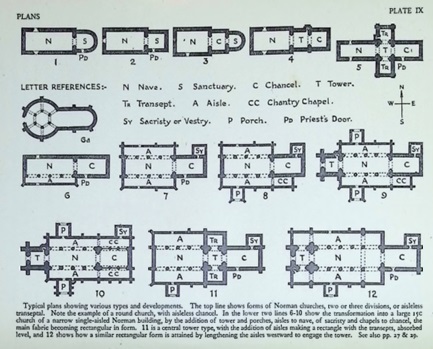
FONTS AND COVERS
Sanctuary. That part of the church occupied by the high altar.
Chancel. The Eastern part of the church, separated from
the nave by a screen (see Plate XI), and used by the deacons and
servers assisting the priest in the services.
Sacristy or Vestry. A room, with the entrance inside the
church, for keeping sacred vessels, vestments and other valuables
in. The priest used it to deck himself for the services.
Chantry. A Medieval ecclesiastical endowment for maintaining
priests to chant Masses for the soul of the testator or others named
by him. This act was considered to be the surest way to secure
the soul’s welfare. The testator, or members of merchants’ and
craftmen’s guilds, often provided a chapel for the purpose, con
taining the tomb of the testator.
FONTS AND COVERS
Fonts, Nos. 1 to 4, 7 to 11 and 14. These are generally situated
near the main entrance at the West end of the church. In Medieval
Times the baptismal service began in the porch, or outside the
door if the church did not possess a porch, and finished at the font.
Few authentic Saxon fonts remain. In many cases wooden
tubs were used. There are a large number of Norman fonts.
Being constructed of large stones, and bearing no weight, and
because of the sanctity attached to the rites associated with them,
they were preserved when the Norman church was altered, and
rebuilt. The design of the font was suggested by the prevailing
type of architecture. Most fonts were made of stone, some of
lead, and in the 13th century a number were of marble. These
usually had but little carving, the polished marble itself adding
richness to the effect.
Early fonts were tub-shaped, large and deeply hollowed. In
Saxon times adults stood in the font and water was poured over
them. Later, when the baptised were mostly children, these were
immersed, and so the font was raised on a low stand for convenience; when, later still, sprinkling became the custom, the
bowls were made smaller and raised still higher on pillars, Nos. 8

FONTS AND COVERS
and 11, or pedestals, Nos. 9 and 14. In the 15th century the
pedestal sometimes stood on a flight of steps. These different
methods of baptising account for the lack of unified design, and
for the fact that some bowls are of an earlier date than the base
they stand on. There were stereotyped designs in all periods,
but the exceptional ones are usually more interesting, Nos. 1, 2,
3 and 10. Weird beasts and figures carved on some Norman
fonts probably symbolises the escape of the soul from evil through
baptism. The large variety of design in fonts adds much to the
interest of our old churches.
The illustrations show a few of the different forms that have
survived. The comers of square fonts, No. 3, were, in Medieval
Times, for the candles and vessels of oil and salt used at the baptismal ceremony. Lead fonts, No. 2, were made by stamping
wooden patterns in a sand mould, pouring the molten metal in,
and afterwards bending it round and soldering. Most 14th and
15th century fonts were octagonal in form, many being of graceful
proportions, while some were elaborately carved with designs
representing the seven cardinal virtues or seven sacraments. The
seven virtues are Faith, Hope, Charity (called the Holy Virtues),
Prudence, Justice, Fortitude and Temperance. The seven sacraments are Baptism, Confirmation, the Eucharist (Mass), Penance,
Ordination, Matrimony and Extreme Unction. Other favourite
subjects were symbolic representations of the four Evangelists
(see Plate XXVI) and heraldic devices.
Covers, Nos. 6, 12 and 13. Very early fonts did not have
covers. In the 13th century the Archbishop ordered that covers,
which were flat, should be locked. The water being consecrated,
people, believing it contained some magic power, tried to steal it
for superstitious purposes. On some fonts can be seen the staple,
or place where the staple was, which was used in fastening the
lid, Nos. 5 and 7. Some covers, known as rim buffets, No. 12,
are permanently fixed to the top of the font, and possess a door
which could be locked, while others are in the form of floor buffets
which enclose the whole font completely. Very large elaborately
carved covers, No. 13, belong to the 15th century and require a
pulley with rope or chain to raise them.
CHANCEL SCREENS
Screens are used in churches for various purposes: to enclose
the choir, to separate chapels from the chancel or nave, in which
case the screen is known as a parclose, and to protect tombs.
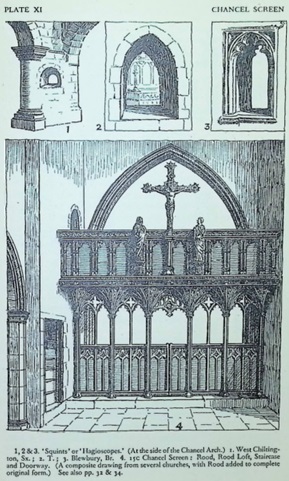
Chancel Screen, No. 4. In Medieval Times the chancel was
reserved for the priest and his assistants, and the nave for the
congregation, as the screen, with its locked doors, was used to
keep the people, and dogs (who were the scavengers of those days),
from the chancel.
Early screens were of stone, but in the late 14th and 15th
centuries oak was used. Over the screen was the Rood beam on
which was fixed the Rood (an image of Christ on the Cross with
figures of the Virgin Mary and St. John). The Rood was the dominating feature of the Medieval church. The figures were destroyed
at the Reformation, but No. 4 gives some idea of their appearance.
The Rood beam sometimes became embodied in a wooden
screen, and the top of the screen was in the form of a loft, approached
by a staircase and door in the wall at the side, No. 4. The loft
was often used for a small organ, for soloists of the choir, to read
the Gospel from, to facilitate the decking of the Rood with foliage,
and for the lighting of candles on the upper part of the screen on
festival days. The ceiling over the screen was richly decorated
to show the sanctity of the Rood. A lamp in front of the Rood
was always alight, and during Lent the Rood was covered with a
veil. In some churches there was a window, high up on the South
side, to light the Rood.
Highly skilled wood-workers of the 15th century put their
best work into these screens. They were enriched with beautiful
carving, as those screens that still remain show. The screens,
like all other wood and stone work, were coloured and gilded,
the lower panels of some being painted with pictures of saints.
Traces of colour can still be seen in a few churches. Unfortunately,
the mistaken zeal of the 16th century Reformers destroyed most
of these beautiful screens, and later, Parliamentary .troops made
havoc of much of the Medieval craftsmen’s lovely work in our
churches. A number of fine old screens remain in East Anglian
and Devon churches. If the screen is missing, the staircase, door
or corbels for the Rood beam may sometimes be seen. In Medieval
IN THE CHANCEL (TABLES, CHAIRS, ETC.)
Days, miracle plays, the Passion play at Easter and Nativity play
at Christmas were performed in front of the chancel screen.
‘ Squints ’ or ‘ Hagioscopes,’ Nos. i, 2 and 3. In some churches,
cut at an angle through the wall at the side of the chancel arch, is
an opening, Nos. 1 to 3. This gave people in the aisles a view
of the high altar. Then, if a priest was officiating at an altar in
the aisle, he could use the squint to view the high altar and thus
synchronise the two services.
IN THE CHANCEL (TABLES, CHAIRS, ETC.)
Altar, No. i. The altar at the East end of the chancel was
known as the high altar. The ceiling over it was often richly
decorated. Prior to the Reformation most altars were of stone,
with five crosses (one in each comer and one in the middle),
signifying the five wounds of Christ. The few remaining ones
now in use are mostly found in Chantry chapels. Some were used
in floors and walls during rebuilding after the Reformation. To
keep the draughts from the candles on the altar, curtains, often
beautifully embroidered, hung North and South of the altar.
Some stone altars contained the bones of saints. In Medieval
Times, during Lent, a veil was hung in front of the altar, suspended from a cord attached to staples about eight feet from
ground on the North and South walls. Some of these staples
still remain.
Reredos, Nos. 2, 3, 11 and 13. The East window, with
brackets and niches containing figures of saints on either side of
the altar, and the space between the top of the altar and window
sill formed the reredos; this space being decorated with canopied
niches of stone or alabaster containing carved figures, or some
times panelled with paintings. The favourite subjects were the
twelve Apostles, holding their appropriate emblems, and scenes
from the Passion. Few churches retain the old reredos, most
having embroidered hangings or wooden panels instead. Some
churches in the 17th and 18th centuries used panels containing
the Ten Commandments, the Lord’s Prayer and the Creed. These
panels, with some modern reredos, are so large that they cover

IN THE CHANCEL (SEDILIA, PISCINA, ETC.)
part of the East window and detract from the beauty of it. A
reredos was used at the back of altars in the chapels and aisles.
Pyx Pulley. Usually housed in a socket in the ceiling, No. 4,
and used to raise and lower the pyx.
Communion Table, Nos. 10 and 14. After the Reformation,
a table replaced the stone altars, and was moved to the middle of
the chancel for the Communion service while the congregation
sat or stood round it. Some strong-minded Puritans placed the
table in the nave. Elizabethan tables, No. 14, were given a rich
decorative appearance by wood-carvers, but Jacobean ones are
plainer. The beautiful colour of the old oak is worth noting.
Credence, No. 5. A small stone table on which stood the
wafers and wine before they were consecrated at the altar.
Brackets, Nos. 6, 7 and 8. Carved stone brackets on which,
in Medieval Times, carved images of the Virgin Mary or saints
used to stand. These figures were draped with veils during Lent.
Oven, No. 12. Ovens in churches were used to bake the wafers
for Mass, and to heat the charcoal for incense-burners.
Chairs, Nos. 9 and 15. A special chair on the North side of
the chancel which is used for the bishop officiating at the Confirmation service and other functions. Some of these chairs are
excellent examples of the woodwork and carving of old craftsmen.
IN THE CHANCEL (SEDILIA, PISCINA, ETC.)
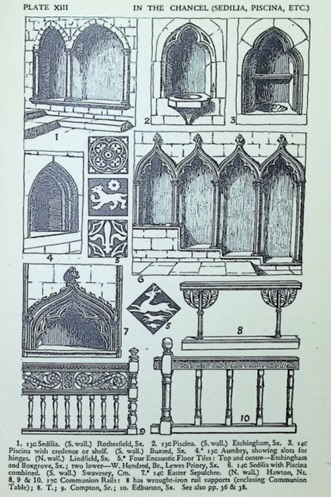
Sedilia, Nos. i and 6. This was usually the most ornate
feature of the chancel. In Medieval Times, during Mass, the
priest was the celebrant, the deacon read the Gospel and the sub
deacon read the Epistle. They were seated in the sedilia while
the Creed and Gloria were being sung, giving them a period of
rest during the long ceremony. The seats were often of three
different heights; the priest sat on the highest one, nearest the
altar. Later, when Chantry endowments provided some churches
with several clergy in full orders, seats were on one level. Some
sedilias have two seats, others three, while a few have four, the
extra one being for the clerk. Note No. 6, how the chancel floor
has been raised in more recent times, the sedilias not being used now.
IN THE CHANCEL (SEDILIA, PISCINA, ETC.)
Piscina, Nos. 2, 3 and 6. A basin, with a drain leading to
the consecrated ground of the churchyard, for the priest to wash
his hands before Mass and to wash the vessels after the ceremony.
Some have a shelf, No. 3, called a credence. The sacred vessels
used at Mass stood on this. A piscina may be seen in the aisle
or in other parts of the church, denoting that an altar stood there
at some time.
Aumbry, No. 4. A small cupboard for storing the vessels
containing the holy oils used at the baptismal service and the
oil for anointing the sick when they were very ill. These oils
were blessed and prepared in a cathedral by the bishop on Maundy
Thursday. Most wooden doors of aumbries have disappeared,
but the slots for the hinges and the lock can often be seen.
Tiles, No. 5. Not many old encaustic tiles, used for the
floor of the chancel, remain. Many floors have been raised since
Medieval Days. Tiles were made of a red clay, a pattern being
stamped in by a wooden die while the clay was still wet, then
filled in with a white clay, and yellow glaze put over the tile and
fired in a furnace. Some tiles have very interesting and curious
designs.
Easter Sepulchre, No. 7. A recess in the North wall of the
chancel, or a canopied tomb used for the purpose (usually carrying
out a request in the will of the deceased). On Good Friday, in
Medieval Days, the Host and altar cross were placed in the sepulchre
and watched day and night until they were removed, with high
festival, to the altar early on Easter Sunday. This procedure
signified the burial and resurrection of Christ from the tomb.
Altar Rails, Nos. 8, 9 and 10. These were erected in the late
16th century, and nearly all churches had them by the end of the
17th century. Archbishop Laud was shocked at the irreverent
attitude of people when the Communion table was placed in the
middle of the chancel (see page 36). He gradually influenced
church officials to move the tables to the position of the old stone
altars (see page 34) at the East wall of the chancel, and to erect
altar rails for people to kneel at during the Communion service.
These rails also served to keep dogs from defiling the tables.
STALLS, PULPITS, LECTERNS
Choir Stalls, No. 7. Some choir stalls of the 15th century,
that age of wonderful woodwork in our churches, still remain,
with their fine carving giving additional beauty to the chancel.
In Medieval Times, priests, clerks and monks had to stand during
long services; the sloping tops of the stalls were useful to rest
their arms on and thus give them support.
‘Elbows,’ Nos. 2 to 5. The carved projection on the ends of
the stalls, often adorned with quaint and picturesque carved figures,
birds or animals.
‘Misericords,’ Nos. 6, 8, 9 and 15. Some choir stalls have
small hinged seats (somewhat like to the tip-up seats in theatres),
with brackets underneath usually carved with quaint figures,
hunting and farm scenes, and incidents of everyday life. The
wood-carvers were evidently free to give full play to their imagination, for the results are often most amusing. The small
seats were used as a rest for the aged and infirm during long
services.
Pulpits, Nos. 1, 16 and 18. Sermons were first given from
before the altar, then from the West end of the chancel, and
sometimes, it is thought, from Rood lofts, until pulpits were used.
Most early pulpits were of oak, and very small, as though the
priests were not nearly so big as those in more recent times.
Preaching was general in the 15th century. In 1603 church
wardens were ordered to provide pulpits in all churches. Some
old ones still remain. Jacobean pulpits, No. 1, with a sounding
board over to help carry the preacher’s voice to the far end of
the church, were often richly decorated with carving. In the
17th and 18th centuries, when galleries to accommodate larger
congregations were erected, and enclosed pews with high backs
used, the ‘three-decker,’ No. 18, was constructed. The clerk
occupied the lowest part, the next was for the reader of the
Scriptures, and the upper part for the preacher. These pulpits are
not very beautiful, and few remain.
Chained Bible, No. 10. In 1536 the clergy were enjoined by
Royal authority to place a Latin and an English Bible in the choir
of every church, where they could be freely read by the people.
These were chained to the desk to prevent loss by theft.

SEPULCHRAL MONUMENTS (COFFIN COVERS, ETC.)
Lecterns, Nos. ii and 12. These are now used to hold the
Bible from which the lessons are read. In pre-Reformation days
they stood in the chancel to hold the service book, or the chanter
for the conductors of choirs singing at Divine Office and Mass.
A few wooden choir lecterns have desks at two levels for standing
or kneeling. Wooden lecterns were usually of a desk form, No. 11,
and many brass ones had an eagle, with dragons at the foot, No. 12,
symbolising the Gospel carried on wings to the four corners of
the earth, and the dragons as evil powers conquered by the Word
of God. Twenty wooden and forty brass Medieval lecterns remain
in Britain.
Hour-Glass Stands, Nos. 13, 14 and 17. Hour-glasses were
introduced in the 16th century and became usual in the 17th
century. One hundred and twenty of these fine wrought-iron
stands remain. In pre-Reformation days hour-glasses were used
to mark the time of meditations or the Scripture readings of private
worshippers, and later, to time sermons. Some hour-glasses re
corded hours and parts of hours. Tong-winded’ preachers used
to turn the glass upside down when the sand ran down, and so
continued the sermon for another spell.
SEPULCHRAL MONUMENTS (COFFIN COVERS, ETC.)
Stone Coffin, No. 9. In the 12th and 13th centuries stone
coffins were in general use for those of eminence or wealth, and
some were buried in the floor of the church, with the lids forming
part of the pavement.
Coffin Covers, Nos. i to 4. Belonging to the 12th and 13th
centuries, some of these were used as flat sepulchral slabs, others
as actual coffin lids. While some of these slabs are found in the
churches as monuments, they may not mark the actual burial
places, as the bodies may have been buried in the churchyard.
The favourite ornamentation of early ones was the cross and
circle, without lettering. Some were carved, No. 1, others incised,
Nos. 2 and 3. Later, the cross was shown on steps, No. 3, called
a ‘calvary.’ On some, on each side of the shaft of the cross, were
symbols to indicate the profession or occupation of the deceased,
No. 2; swords, shields and other weapons were the symbols for

SEPULCHRAL MONUMENTS (COFFIN COVERS, ETC.)
men-at-arms—bows, arrows, axe and horn for foresters—pastoral
staff and chalice for ecclesiastics—shears, gloves, fish, pincers,
bell, etc., for various tradesmen, while keys indicated that the
person held some official post. Later, these slabs were incised
with a figure representing the deceased; next, the carved semi
effigial figure was used, No. 4, developing later still into the complete effigy carved flat and in low relief. Prior to a.d. 1275,
these slabs were smaller at the bottom end than at the top, Nos. 1
to 4, but afterwards were made the same width at both ends.
When a church had additions built on to it, the slabs were often
taken up and used in the rebuilding. Those remaining in the
floor of the church are mainly found in Derbyshire and Yorkshire.
Iron Slabs, Nos. 5 and 6. These are found chiefly in Sussex,
where iron-smelting was carried on in bygone days. Some slabs
consist of a raised cross, No. 5, without lettering, while others had
a coat-of-arms and an inscription, No. 6. These slabs usually form
part of the floor of the church.
Brasses, Nos. 8 and 10. These consist of thin pieces of metal
(a mixture of copper and zinc), let flush into the stone. The
metal was engraved, and the incised lines filled in with a black
substance, while on some coloured enamels were used. They
came in during the 13th century and continued until the 17th
century, the chief centre of manufacture being London. They
form a most complete history of armour and costume. The early
brasses were used by the wealthy people who could afford to pay
for good work, but later there were cheap substitutes used by the
new middle classes. The engraving deteriorated after the Black
Death, a.d. 1349-50, and figures were made smaller. The finest
collection of brasses is at Cobham, in the county of Kent. After
the Reformation, some of the metal was stolen for other uses.
In many churches can be seen the recess in the stone monuments
from which the metal has been taken. There are about five hundred
brasses still remaining in England.
Ledger Stone, No. 7. In the 17th and early 18th centuries,
when the art of making brasses declined, a School of heraldic
sculptors arose. They carved massive floor slabs of a hard bluish
grey stone. The carving was low in relief, so that these stones,
let into the floor of the church, would not impede those walking
about. The decoration of these slabs usually consists of a coat
of-arms at the top with an inscription under it.

SEPULCHRAL MONUMENTS (EFFIGIES, ETC.)
Monuments erected to the memory of the departed are common
in our churches. Many 13th to 15th century tombs are splendid
examples of the Medieval craftsmen’s work in marble, stone,
wood, alabaster and bronze, adding beauty and richness to our
churches. These monuments, like all Medieval church stone and
wood work, were richly coloured and gilded, but in Puritan times
were whitewashed, and later scraped, so that only traces of colour
remain on a few. Some tombs have beautifully carved canopies
over them. Heraldry, an artistic form of decoration, identifying
persons, and marriages between families, was used from the time
of Edward I onwards.
Effigies, Nos. i and 3. Many tombs, shaped like a huge box,
and known as table or altar tombs, have effigies lying on top.
Carved figures representing Christ, the Virgin Mary, saints and
martyrs were destroyed at the Reformation, but effigies remain to
display the fine work of some Medieval sculptors. These figures,
usually life-size, while representing the deceased person, are not
necessarily portraits—in fact, most effigies portray the person in
the prime of life. When other materials were difficult to obtain,
oak was used; about ninety of these remain. Prior to the Reformation, the effigies were shown in a reverent attitude, with hands
folded in prayer, No. 1, but in the 17th century lolling on the
elbow, No. 3, and other irreverent attitudes were used. In the
16th century the kneeling position, No. 14, was popular. Children
kneeling denote submission to their parents. Renaissance ornament then began to replace Gothic details. Effigies, with brasses
(see Plate XV), are valuable aids for the study of Medieval armour
and costume.
The approximate date of a tomb can be ascertained by studying
these costumes, particularly die head-coverings (see Plate XVII).
The head of the effigy in armour usually rests on his helm, while
a lion, No. 12, at his feet symbolises bravery. A dog, No. 6, at
the feet of a female indicates fidelity. Other symbols are two
wine-casks for vintners, and sheep or woolpack for merchants.
‘Weepers,’ Nos. 4, 5 and 9. Round the sides of some tombs are
small figures, technically known as c Weepers.’ They represent
the deceased’s family or relatives, angels (often having a shield
with coat-of-arms) and saints. On a few tombs of those who

BENCH ENDS
had founded a chantry or hospital are quaint little figures, No. 10,
representing ‘bedesmen’ (pensioners of the deceased whose duty
it was to pray for the soul of their benefactor).
‘Cadaver,’ No. ii. A gruesome fashion, of the 15th to 17th
centuries, portraying the deceased as a corpse, is found on a few
tombs.
Herse, No. 2. A bronze or iron erection around and above
some tombs of distinguished persons as a protection. At the top
were prickets for candles used at the anniversary .of the death of
the deceased, and at other times.
Mural Tablets, Nos. 7, 8, 13 and 15. Many of these contain
some good lettering and can be roughly divided into four groups:
the lettered panel surrounded by a carved frame, No. 8; the panel
projecting, with surrounding parts receding towards the wall,
No. 13 (with many in this group the ornament is more unobtrusive,
thus giving prominence to the lettering, the most important part
of these tablets); the third group consists of a more elaborate
architectural composition flanked by columns of pilasters, No. 7;
lastly there is the scroll-like ornament, often with cherubs or
cherubs’ heads, and helm, crest and coat-of-arms, No. 15. This
form is known as a cartouche.
BENCH ENDS
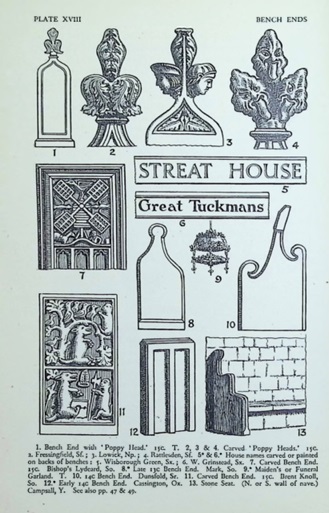
Bench Ends, Nos. 1, 7, 8, and 10 to 12. Fixed seats in churches
came into use in the 14th century, and were universal by the end
of the 15th century, when sermons were more important. In
early times no seats were provided. Congregations stood and
knelt during the services. When processions took place, the
verger headed them to clear a way through the congregation
scattered about the floor. The floor of the church was often bare
earth rammed down and covered with straw and litter. Some
churches had a stone seat, No. 13, attached to the wall for the
aged and infirm persons unable to stand during the services, and
this gave rise to the saying, ‘The weakest go to the wall.’ Early
seats or benches were made of thick oak planks, the ends plain
and flat-topped, No. 12; next, the tops were simply shaped, No. 8,
and later became more decorative, No. 10.
PEWS AND GALLERIES
‘Poppy Heads’ and Bench Ends, Nos. i to 4, 7, 8, 10, 11 and 12.
In the 15 th century, that age of great achievements by wood
workers, the bench ends were often richly decorated with carving.
Wood-carvers were given a free hand and showed considerable
imagination, with often a fine sense of humour. The tops of some
bench ends were finished with carved decoration known as a
‘poppy head,’ from the French word poupee. (puppet or figurehead).
These often took the form of weird animals, grotesque heads and
figures. Many wealthy people, in their wills, left money for
carved bench ends, so not only “poppy heads,’ but carved panels,
Nos. 7 and n, added to the richness of the effect. The subjects
carved were varied and interesting. No. 11, for instance, indicates
that the wood-carver evidently had a grudge against the Abbot,
for the top panel shows an ape inciting geese to rebel against the
Abbot (represented as a fox), while in the lower panel the fox is
handcuffed, with its feet in the stocks, and guarded by the heads
man (an ape with an axe). The prisoner’s mitre hangs on the
wall. Symbols of the Passion (see Plate XXVI) were carved on
some bench ends, and also used in stained-glass windows. After
the Reformation, the ruthless destruction, carried out by the
Puritans, of much of the beautiful 15th century woodwork led to
the loss of many of these lovely old bench ends.
Mansions and farmhouses near the church often had one or
more benches reserved for members of their household. The
names of these houses were carved or painted on the backs of the
benches, Nos. 5 and 6.
Maiden’s Garland, No. 9. At the death of a maiden in
Medieval Days a garland, consisting of real or imitation flowers,
with the maiden’s collar, glove or handkerchief attached, was
carried in the funeral procession and afterwards suspended over
the empty seat of the departed girl. Few of these remain in our
churches.
PEWS AND GALLERIES
Musicians’ Gallery, No. 1. During the reign of Queen
Elizabeth, when she stripped our churches of most of the fittings
and objects used in Roman Catholic services, Rood screens (see
Plate XI) were taken down and many destroyed. Parts of them
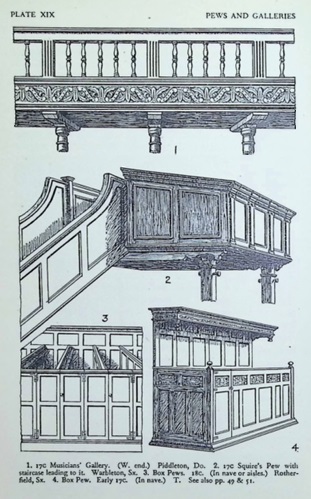
PEWS AND GALLERIES
were sometimes used in building a gallery at the West end of those
churches that needed one. After the destruction of the organs
used in churches in pre-Reformation times (see page 64), these
West galleries were used by the village orchestras and choirs
(see page 64). During the singing of the hymns the members
of the congregation used to turn round and face the West gallery.
In the 18th century, when organs began once more to come into
use, some of them were housed in these galleries. During the
late 18th and the 19th centuries, if the congregations increased
much in size, these galleries were useful to accommodate those
unable to obtain a seat in the nave or aisles. For this purpose
some churches had North and South galleries erected also.
Squire’s Pew, No. 2. In Medieval Times patrons of the church
were granted a seat in the chancel, and this was the origin of the
squire’s pew. In the 17th and 18th centuries the squire claimed
a large family seat in the church, sometimes having it in the chancel.
Some of these pews were raised above the floor-level and had a
staircase leading up to them. It is evident some squires believed
in making the accommodation as comfortable as possible, for some
of these pews contained a table, armchairs, and even a stove for
warming the occupants of the pew. Some of these pews were of
a high box form with canopy, No. 4, and were fitted with curtains
and cushions. Later, these box pews were copied by yeomen and
tenant farmers, and their use passed from one person to another
with the tenancy of the farm. High box pews were familiarly
known as ‘horse-boxes.’ Then, later still, smaller and lower box
pews, No. 3, were built for the use of the rest of the congregation.
As churches in those times were cold and draughty in winter,
without the efficient warming devices we are accustomed to in
many churches to-day, these box pews made conditions more
comfortable, helped to keep out the draughts and prevented the
dogs from being a nuisance. Many of these pews were rather
ugly and clumsy in appearance, and often some of the beautiful
carved Medieval benches (see Plate XVIII) were destroyed to make
room for them.
MISCELLANEOUS (WALL PAINTINGS, CANDLES, ETC.).
Mural Paintings, Nos. i and 2. All churches were decorated
with mural paintings, which added colour, and also taught people
the great events of their religion. Though used prior to the
Norman Conquest, most of those remaining belong to the 15th
and early 16th centuries. The favourite subject over and around
the chancel arch was ‘The Doom’ (this illustrated the resurrection
of the dead and the last judgment. Angels were shown carrying
the just to Heaven, where Christ sat enthroned, while devils were
dragging the others to the mouth of Hell). St. Christopher, No. 1,
was a common subject, usually painted on the wall opposite the
main entrance, for the people believed that if they caught a glimpse
of him as they entered the church, and offered a prayer, they
would be protected from harm for that day. Other subjects often
painted were: St. George and the Dragon; St. Michael weighing
a soul in the balance, with the Holy Virgin standing by in prayer
and devils trying to drag down the other side of the scale. Other
decorations painted were shields, scrolls and sacred monograms.
The Puritans covered all mural paintings with whitewash, which
has now, in some churches, been carefully removed, revealing part
of these fine old pictures.
Candles and Tapers, Nos. 3 to 6 and 10. Apart from giving
light, these, in their holders, added beauty to the church. The
rushlight holder, No. 4, may have inspired the designers of the
elaborate brass candelabra, No. 5, which, when filled with lighted
candles reflecting in the polished brass, have a lovely effect.
Decalogue, No. 7. Churches stripped during the Reformation
of objects used in Roman Catholic services appeared bare. To
remedy this, and for the edification of the people, Queen Elizabeth
ordered panels with the Ten Commandments, the Lord’s Prayer
and the Creed to be set up. These, with the Royal Arms, were
often placed under the chancel arch in place of the discarded Rood.
Consecration Cross, No. 8. Painted, three on each of the
four inside walls of a church, they were used for the same purposes
as the external ones (see page 19).
Hatchment, No. 9. A painting, on a board about four to five
feet square, which was exhibited on a dwelling-house for several
months after a death, then placed in the church. The painting

CHESTS AND BOXES
consisted of a shield, on which were the armorial bearings, crest
and motto of the deceased person. The background was black
in part or whole, thus defining distinctions between married persons,
widowers and widows, bachelors and spinsters. Hatchments were
introduced in the second half of the 17th century. Few had
artistic merit.
Bequest Board, No. ii. These boards recorded provisions
made in wills of kindly disposed persons for money for charitable
purposes. The lettering on some of these boards, as in No. 11,
was not well drawn or spaced, and thus did not add to the beauty
of the church.
Royal Arms, No. 12, were painted on panels, carved in wood,
embroidered, or painted on glass. When the Pope’s jurisdiction
in England was repudiated in 1536, and the King made himself
head of the Church of England, the Royal Arms were introduced
into our churches. In Queen Mary’s reign nearly all were destroyed;
then the number increased in subsequent reigns up to the Common
wealth, when again large numbers were destroyed. In 1660 the
display of them was compulsory, but in the 19th century the
practice gradually fell into disuse.
CHESTS AND BOXES
Chests, Nos. 2, 3 and 5. In Medieval Days chests were important pieces of furniture and usually kept in the sacristy. In
them were kept the churchwardens’ accounts, wills of parishioners,
and, after the Reformation, the church doctrine books which
every parish had to provide, and also parish registers. The keeping
of the parish registers began in 1538, and by 1597 Queen Elizabeth
enforced the order in every church. These registers are valuable
and extremely interesting, containing, as they do, entries of the
births, baptisms, marriages and deaths of the parishioners, accounts
of gifts to the poor, the doings of the people of the parish, the
coming and going of the vicars and the various families of the
district, fast days and festival days, special weather conditions, etc.
From these registers can be gathered an idea of the social conditions
of the days in which the entries were made. Large chests were
provided in Medieval Times for storing the rich and elaborate

CHESTS AND BOXES
vestments used for the church services and processions. English
embroidery was famous for its beauty. Unfortunately these lovely
examples of the art were, at the Reformation, pulled to pieces for
the gold and jewels on them, but some churches still possess altar
frontals or pulpit cloths made from a Medieval cope. Such frag
ments give an idea of the splendour and colour displayed by even
the humblest parish priest when robed in the church. Chests
from the 12th century onwards still remain in our churches. The
earliest ones were roughly cut out of a tree trunk, No. 2. A slot
in the lid of a chest, No. 3, was for ‘Peter’s pence’ (contributions
of the faithful for the support of the Pope). Some chests had
three locks. No. 3 has wooden patches where locks were once
fixed on it. For these chests there were three different keys, one
held by the parson and the other two by churchwardens; thus all
three had to attend before the chest could be opened.
Bible Box, No. 1. Early copies of the Bible were scarce and
expensive. Locked boxes protected them and kept them clean.
‘Chip carving’ (decoration in low relief), No. 1, was used on
some of them.
Alms Boxes, Nos. 4, 6 and 8. The giving of alms has always
been thought of as a Godly virtue. Early boxes were made from
roughly hollowed pieces of tree trunks with iron bands to strengthen
them, No. 4. Some later ones gave the wood-carver a chance to
display his art, No. 6, while metal with enamel was used in a few
cases, No. 8. Quite a number of these old alms boxes remain.
If you enjoy visiting our old churches, please remember that
money is necessary to keep them in repair. Boxes for your contributions can usually be found on the West end of the church.
‘Dole’ Cupboard, No. 7. In Medieval Times it was the custom
of some generous persons to bequeath money for a ‘dole’ of bread
for poor people. These persons had to attend the Sunday service,
the bread being presented to them at the end of the service. The
‘Dole’ cupboard was used to keep the bread in until required.
Part of the door had openings in it for ventilation. Some cup
boards were beautifully carved in oak. Many of these cupboards
and Bible boxes, No. 1, have found their way into the houses of
collectors of antique furniture.
Coffin Stools, Nos. 9 and 10. Craftsmen in bygone days
often constructed well-designed oak stools for coffins to rest on
ROOF TRUSSES AND CORBELS
during the funeral service. Nowadays most churches have plain
deal trestles for the purpose. In a few churches one of the old
biers, used for carrying the coffin, may still be seen.
ROOF TRUSSES AND CORBELS
Roofs, Nos. 1 to 9 and 19. Stone ribs, in the form of arches,
built up to support a stone ceiling, form a construction known as
groined vaulting, No. 1. This was confined mainly to large
churches, as was the beautiful Tan-tracery’ vaulting, No. 19. The
almost universal type of parish church covering was a timber
roof covered with thatch, lead, terra-cotta, or stone tiles, or
Thingies.’ English craftsmen excelled in these beautiful wooden
roofs. Little remains of Norman roofs. In the 13th century the
roofs were generally high pitched, lower in the 14th century, and
lower still in the 15th century.
The general construction of roofs consisted of roof trusses of
various shapes, Nos. 2 to 9, placed at regular intervals, with long
beams, called purlins, fixed at right angles to the principal rafters
for supporting the common rafters, on which the roof covering
was fixed. As the weight of the roof tended to spread the principal
rafters outwards, structural and decorative elaboration of roof
trusses was primarily due to strengthening devices to prevent this,
consisting chiefly of tie-beams and collar-beams with braces to
add further strength, Nos. 2, 3, 5 and 6. In the 15th century a
truss, known as the ‘hammer-beam,’ Nos. 7 to 9, was devised,
which put less lateral pressure on the walls than other forms. It
was the most decorative form of all roof trusses, being often
enriched with carving on the hammer-beams and arched braces,
Nos. 10 and 11. Most timber roofs are open to the rafters, but
some are boarded in, one form being called a ‘waggon roof,’
No. 4, as it resembled in shape the canvas tilt over old carriers’
waggons. Where ceilings were used, they often had panels
separated by moulded ribs with carved bosses, No. 12, at their
intersections.
Reaching towards the sky, the roof probably
appealed to wood-carvers as the correct place for angels, for many
adorn some roofs, Nos. 10 and 13. It is always worth while
standing at the end of the church and looking up at these old
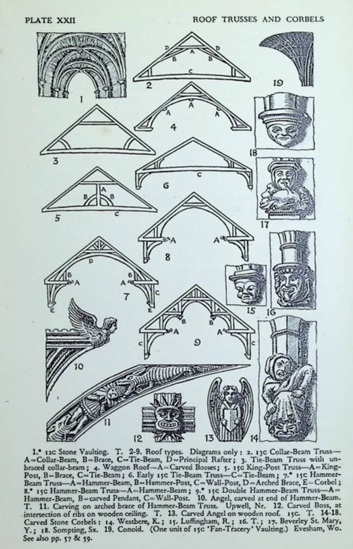
ARCHES AND MOULDINGS
roofs, with their massive roughly hewn oak beams in the early
and smaller churches, and the elaborate and beautifully carved ones
of the 15th century in the larger churches. A pair of field or opera
glasses is useful for this purpose. Some still retain traces of the
colour with which they were painted and gilded in Medieval Times.
Corbels, Nos. 14 to 18. Wall-posts of roof trusses, No. 7,
usually rested on stone corbels, many of which gave stone-masons
an opportunity to display their imagination and skill in carving.
Some corbels with their weird fantastic heads and figures are
often most interesting, and sometimes amusing as well. In the
naves of a few churches the carved corbels represent, in the North
wall, the seven deadly sins, known as pride, wrath, envy, lust,
avarice, gluttony and sloth. Then on the South wall opposite to
these would be representations of the seven virtues, faith, hope,
charity, prudence, justice, fortitude and temperance. Other
corbels may have carved on them the symbols of the four Evangelists
(see page 69), or heads of the reigning monarch and his wife, abbots,
and patrons, while occasionally the master mason carved his own
portrait.
ARCHES AND MOULDINGS
Arches and Mouldings, Nos. 1 to 5, 12, 17 and 28. Arches
span the openings between chancel, nave and aisles, and the heads
of windows and doorways. Saxon, No. 12, were semi-circular in
shape, with few and very plain mouldings. Norman, Nos. 1 and
17, were semi-circular, the chief characteristic being a series of
concentric rings, each one projecting more than the one under it.
Some mouldings were plain, but many were richly carved with
ornamental forms, Nos. 6 to 11 and 16, the last one being the most
popular. Other mouldings had the ‘beak-head,’ Nos. 19 and 20,
carved at intervals. Inside some churches mouldings are still as
sharp and clear as when first carved 800 years ago. Norman
masons displayed much imagination, some of their carving is most
quaint and interesting, Nos. 19 to 21, 23, 24 and 27. Arches in the
13th century were very pointed at first, No. 2, and known as
Lancet’ arches, from their resemblance in shape to a surgeon’s
lancet. Exerting less side-thrust than Norman arches, they are
stronger. Later arches in this period are less pointed. Mouldings,
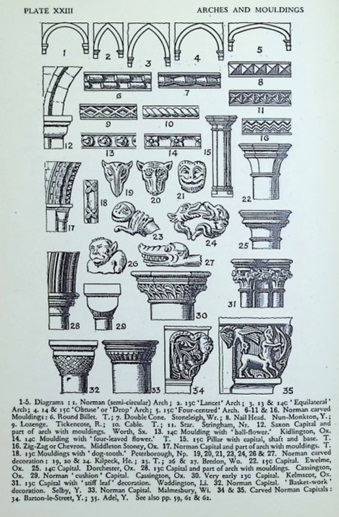
ARCHES AND MOULDINGS
consisting of rounds and hollows, were very deeply cut, for,
windows being small, interiors were rather dark, so shallow
mouldings would appear too flat. On some, the ‘dog-tooth’
ornament, No. 18, was used. In the 14th century arches were less
pointed, Nos. 3 and 4, some being of the ogee shape, segmental and
flat (see Nos. 8, 10 and 11, Plate VI). Mouldings were more
shallow, contrast of colour being relied on rather than deep shade
and light. They were sometimes ornamented with the ‘ball
flower’ and ‘four-leaved flower,’ Nos. 13 and 14. Foliage was
used for decoration copied from nature, the briony, oak, maple
and vine being common. 15th century arches became flatter still,
the four-centred one, No. 5, being popular. Mouldings were
very shallow, sometimes carried right round the arch down to the
floor. Arches are not a safe guide to date a building by, as the
shape used was sometimes a matter of convenience. Mouldings
are more reliable to ascertain the period by.
Pillar, No. 15. Pillars are used to support arches. They
consist of a base, shaft, and the capital from which the arch springs.
In churches, pillars are used chiefly for the arches separating the
nave from the aisles. Norman pillars are short and massive,
usually circular, some octagonal, while the shafts of some are
decorated by channels or flutes cut in various forms, spiral, zig
zag, etc. Other pillars are compound, consisting of flat and round
faces combined. Early English Gothic pillars are circular or
octagonal, others consisted of a large circular central shaft with
smaller circular shafts clustered round it. In the Decorated Period
some consist of a square pillar placed diagonally with round shafts
attached to it. There are also plain octagonal shafts. Perpendicular
Period pillars are usually octagonal, though some are square,
placed diagonally, with mouldings running from the base right
round the arch itself.
Capital, Nos. 12, 17, 22, 25, and 28 to 35. The cap or capital
rests on top of the shaft of the pillar, the shapes varying in
succeeding centuries.
Norman capitals, Nos. 17, 29, and 32 to 35, provide the greatest
variety. The masons of this period showed much ingenuity.
13th century ones, Nos. 28, 30 and 31, have mainly plain mouldings (hollows and rounds), or with carvings of stiff leaf shapes
growing upwards. The plain mouldings of the 14th century,
No. 25, are more shallow than those of the preceding century,
MISCELLANEOUS (LADDERS, IRONWORK, ETC.)
some having carved decoration of natural-shaped leaves in horizontal bands. In the 15th century capitals are generally octagonal
in plan, with shallow mouldings, No. 22.
MISCELLANEOUS (LADDERS, IRONWORK, ETC.)
Belfry Ladders, Nos. i and 2. The belfry was reached in some
towers by means of a staircase-turret (see Plate IV), or by stairs
built in the thickness of the wall. Those without these facilities
had ladders by which access to the belfry could be gained. These
ladders were often rudely constructed of massive timbers, but were
strong and served their purpose quite well. Most of them were
fixtures, but some early ones could be drawn up into the belfry
and thus aid in defence if the church was attacked.
Armour, Nos. 3 and 5. From the time of Edward II, each
parish had to furnish and equip soldiers for home service. Their
armour was kept in the church for safety in the charge of the
churchwardens, and was thus ready for use when required. After
the death of the lord of the manor, or other important person,
his helm, gauntlets, spurs, No. 3, banners and pennons, with
coat-of-arms, were suspended over his tomb in the church,
this funeral helm, etc., often being specially made, as the genuine
war gear was too expensive to be used for this purpose. Many
of these objects have been stolen, but some churches still possess
these examples of the armourers’ art.
‘Brank’ or ‘Gossip’s Bridle,’ No. 4. In bygone days, women
who were guilty of spreading false information about their neighbours were forced to wear the gossip’s bridle for a certain period.
This steel frame was made to pass over and around the head, with
the ‘bit’ in the mouth to keep the tongue down by pressure and
so prevent the wearer from talking. The nose passed through the
aperture in front, and the whole was fastened at the back by a
padlock.
Iron Door, No. 6. Some of our churches still contain specimens of lovely wrought-ironwork of the Medieval smiths. No. 6
is a beautifully designed door, and other examples of ironwork
are seen in escutcheons, locks, hinges, keys and scroll-work on
doors (see Plate VIII), grilles, iron railings, prickets for tapers,

MISCELLANEOUS (MUSICAL INSTRUMENTS, ETC.)
No. 9, ornamental headed stanchions for windows, etc. Great
skill was shown in fashioning ornamental details in iron in the
form of animals’ heads, leaves and flowers.
Clock ‘Jack,’ No. 7. As early as the 12th century there were
some mechanical clocks, but clock dials were not used until the
14th century, and even up to the 17th century simple village
clocks had no dials. Hours and divisions of hours were struck by
ingeniously devised automatic figures termed ‘jacks.’
Sword Rest, No. 8. To sit in a pew wearing a sword was
uncomfortable, so it was necessary, in churches where civic dignitaries attended, to provide a convenient receptacle where the
sword could be left during the service—much as people expect,
in these days, a stand for umbrellas. Racks for wigs were also
used.
Banner Cupboard, No. 10. In pre-Reformation days, processions in and around the church formed an important part of the
services on Sundays and Feast Days. For these processions, incense, banners and garlands were used, with the clergy in their
beautiful embroidered robes adding to the picturesque appearance
of the scene. Cupboards to store the staves for the banners and
crosses were provided. They were usually about 7 to 12 feet in
height, 1 foot 6 inches wide and 1 foot in depth. While some of
these cupboards remain, few retain their oak doors.
MISCELLANEOUS (MUSICAL INSTRUMENTS, ETC.)
Organs were used from the 10th century onwards. By the
13th century many large parish churches had one, and a number
of the smaller churches possessed one by the 15th century. These
early organs were small and simple compared with modern ones.
Some of them were housed in the Rood loft (see page 32). The
Puritans waged a campaign against the use of organs and nearly
all the beautiful carved wooden cases were destroyed. A few
churches still have one of the old barrel organs, operated by turning
a handle, and on which eight to ten tunes can be played.
From the late 17th century to the middle 19th century village
orchestras supplied the music in churches. The musicians often
occupied the gallery at the West end (see Plate XIX). The usual

MISCELLANEOUS (MUSICAL INSTRUMENTS, ETC.)
instruments were the bassoon, hautboy, clarinet, bass-fiddle,
violoncello and flute.
Vamp-Horn, Nos. i and 12. A form of megaphone which
came into use in the 17th century. The conductor of the orchestra
hummed through this horn, giving body and harmony to the other
instruments. Five of these still remain.
Pitch-Pipe, No. 2. A wooden pipe, blown by the mouth, and
having a stopper that can be moved in and out to regulate the
note produced, was used by the conductor of the choir to give the
pitch of the notes for vocal music. It was in use from the 17th
century to the first half of the 19th century. About twelve of
these remain.
Serpent, No. 4. A bass wind instrument derived from the old
wooden cornet.
Hautboy or Oboe, No. 6. The treble member of the wood
wind instruments.
Bassoon, No. 9. A reed instrument which served as bass to
the hautboy and clarinet. A favourite instrument in the 17th and
18th centuries.
Beadle’s Mace, No. 3. The beadle was the messenger of the
parish, and thus to a certain extent an ecclesiastical officer, but he
really acted more as a constable, keeping order in the church and
churchyard. He attended on the clergy, churchwardens and vestry.
He was appointed by the parishioners and paid out of the church
rate. From 1601 to 1834 he was an officer of much importance.
Constables’ Truncheons, Nos. 7 and 8. Some of the 19th
century truncheons, decorated with hand-painted ornamentation
including the Royal Arms, were picturesque as well as useful.
Dog-Tongs, No. 5. Dogs were useful as scavengers in bygone
days and often wandered into churches. In sheep-farming districts
particularly, dogs accompanied their masters to church. Most
churches appointed an ‘expeller’ of disorderly dogs. Whips, and
dog-tongs to grip the neck of the dogs, were used to ‘persuade
the animal to leave the church. These men were sometimes paid
for waking sleeping members of the congregation and for keeping
children in order. Most of the remaining dog-tongs are to be
found in Welsh and Scottish churches.
Collection Plate, Shovel and Ladle, Nos. 11, 14, 15 and 16. Church expenses were met by the church rate, but for special
EMBLEMS AND MONOGRAMS
needs Sunday collections were authorised occasionally and were
known as ‘briefs.’ A few of the articles used to collect the coins
are shown.
Fire-Hook and Fire-Bucket, Nos. 10 and 13. In the days
prior to the invention of fire-engines, attempts to put out fires in
houses and churches were made with primitive appliances. The
fire-hook, on a very long handle, was used to pull the burning
thatch from roofs, or even pull down timber-framed houses.
These appliances, like many other possessions for parish use, were
kept in the church.
EMBLEMS AND MONOGRAMS
The origin of Symbols is attributed to the fact that early
Christians considered it irreverent to write the sacred names
at length. Only a few Christian Symbols can be shown in this
book.
Nimbus. Circular disc (occasionally triangular) at the back of
the head. No. 1, Three rays may signify The Holy Trinity. The
Nimbus of the Virgin Mary was often elaborately decorated.
God. No. 3, Hand issuing from a cloud; No. 4, Hand raised
in blessing; No. 5, The ‘All-seeing Eye.’ Used at the end of the
18th century.
Jesus Christ. Cross: No. 7, Greek; No. 8, Latin (known as
the Calvary Cross), the oldest and most perfect symbol. ‘Agnus
Dei,’ No. 6, Lamb with nimbus, cross (symbol of sacrifice), and
cross-adorned banner (triumphant symbol of the Resurrection).
Christ is also represented by a Pelican feeding its young with its
own blood, and by the Grape Vine (‘I am the Vine’). Monograms, Nos. 9 to 13, the letters from the Greek names for Jesus
Christ: No. 9, first two letters of Christ (‘Χριστός’); No. 10,
first and last letters of Greek alphabet, Alpha and Omega (‘The
Beginning and the End’), added; No. 11, Latin letter N, signifying the word NOSTER (‘Χριστός NOSTER,’ Our Lord Jesus
Christ). The most common one, Nos. 12 and 13, consists of the
first two and last letters of Jesus (‘Ἰησοῦς’), and not, as often
erroneously asserted, the Latin ‘Iesus Hominum Salvator’ (Jesus
the Saviour of mankind).
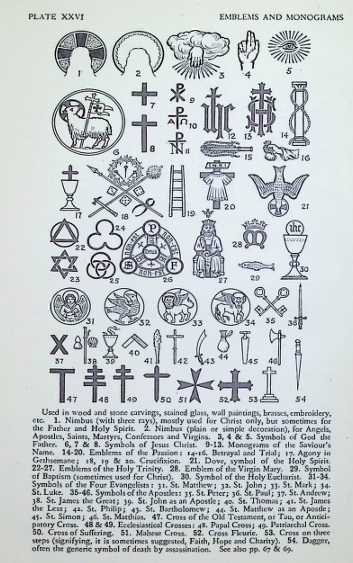
EMBLEMS AND MONOGRAMS
The Passion. No. 14, Pillar and Cords; No. 15, Scourge;
No. 16, Bag of Silver; No. 18, Crown of Thorns, three nails,
hammer and pincers, reed and sponge, spear and three dice; No. 19,
Ladder (typifying the descent from the Cross); No. 20, Cross,
seamless garment and inscription, ‘Iesus Nazarenus Rex ludaeorum’
(Jesus of Nazareth the King of the Jews). Other emblems are the
cock, sword, goblet of vinegar, fist that buffeted Him, ewer used
by Pilate, cup of wine and myrrh, lantern, winding-sheet and
spices in vase.
Holy Spirit. No. 21, Dove. Often has plain nimbus instead of
the one shown.
Holy Trinity. Nos. 22 to 27. The simplest is the equilateral
triangle, No. 22 (perfect equality of three persons of the Godhead).
—Trefoil, No. 24, much used in the 13th and 14th centuries. It
is suggested that St. Patrick took the clover leaf (three leaves in
one) to convey to the Irish people the idea of the mysterious
Godhead.—Solomon’s Seal, No. 23, Jewish symbol for God,
sometimes used for the Holy Trinity.—In No. 26 the letters in
circles are the initials of the Three Persons of the Trinity. The
whole inscription is ‘The Father is not the Son—The Son is not
the Holy Ghost—The Holy Ghost is not the Father. The Father
is God—The Son is God—The Holy Ghost is God.’—No. 27,
Figure of God with Christ on the Cross and a Dove overhead.
Virgin Mary. No. 28, crowned M. (A lily is used also.)
St. John the Baptist. Lamb, or Lamb on a Book.
Eucharist. No. 30, wafer with monogram or cross on it,
issuing from a chalice.
Eternity. A Circle or a ring.
The Evangelists. Nos. 31 to 34, winged man, eagle, lion
and ox.
The Apostles. Nos. 35 to 46. Each one has several emblems.
The principal ones are shown.
Crosses. Nos. 47 to 53. Maltese, No. 51, was borne by the
Knights of St. John and Knights Templars.
Colours are also used symbolically: White—Purity; Red—
Passion of Christ; Blue—Heaven; Violet—Sorrow; Black—
Death.
STAINED GLASS AND CHURCH PLATE
Stained Glass. It is difficult without coloured illustrations to
indicate the beauty of Medieval stained glass. Although used
earlier, it was the increasing size of windows in the 14th and 15th
centuries which gave craftsmen opportunities of filling them with
lovely pictures. Much of this priceless work was destroyed at
the Reformation, but that in Fairford Church, Gloucestershire,
escaped, and this, with fragments remaining in other churches,
gives an idea of the beautiful colour.
Figures of kings and bishops were small in the 12th century, increasing in size in succeeding centuries. Naturalistic foliage was used in
the 14th century, and large canopies in the 14th and 15th centuries.
In the 15th century five-petalled roses appear, and human features
became more natural in appearance. Heraldic devices were used
in the 16th century. Up to the 14th century each colour was a
separate piece of glass held together by grooved lead strips, forming
a mosaic-like pattern, the details depicted by painting with a brown
enamel. Painted glass (pictures painted in coloured enamels on
sheets of glass) came into use gradually, until, by the middle 16th
century, the mosaic method was little used. Many windows in
our churches are filled with 19th century glass, weak in design and
colour, but some good work has been done in the 20th century.
Church Plate. Vessels such as the cruet, pyx, incense-burners,
chrismatory for holy oils, chalice and patten, etc., were splendid
examples of the art of Medieval craftsmen, many being of great
value. Nearly all these disappeared at the Reformation. The
amount of plate now used is small, and is usually kept under lock
and key, so visitors are often unable to see it.
 Holy Scroller